Faceless Channels and the Human Touchpoint: Where a Presenter Actually Belongs
There is a version of the faceless channel that gets sold very hard at the moment. AI writes the script, AI reads it, AI generates the visuals, AI makes the thumbnail, and something schedules the upload. Nobody is involved at any point. It sounds like a machine that runs itself.
I do not think that model has a long future, and not because the tools are bad. They are getting better every quarter. It is because everyone will have them.
Anything available to everybody stops being an advantage. When production is no longer scarce, the scarce thing becomes the reason a stranger would choose your video over the thousand others covering the same subject — and that reason has always been a person.
What the tools removed, and what they did not
Automation removed cost and time. One person can now produce what used to need a small team, which is a genuinely enormous change and I use those tools daily.
What it did not remove is the viewer’s question: who is telling me this, and why should I believe them? A channel with no human presence anywhere has no answer to that. It is not that the videos are worse. It is that there is nothing to become loyal to.
Volume without identity produces a library of content. It does not produce a channel people come back to.
You do not have to be in the whole video
This is the part people miss. "Faceless" is usually treated as binary — either you are on camera for twelve minutes or you never appear at all. In practice, a handful of short touchpoints does most of the work.
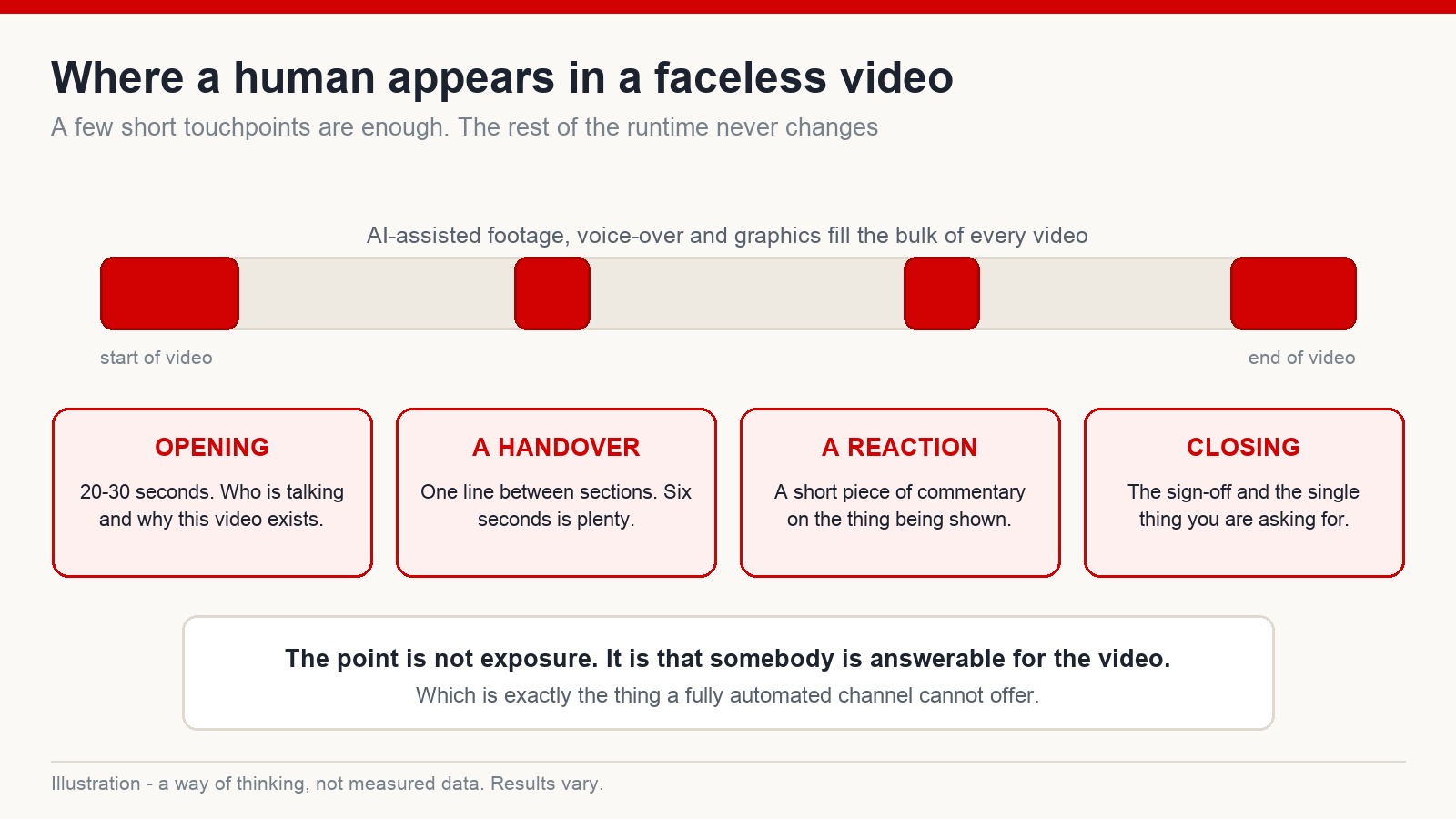
An opening of twenty or thirty seconds. One line handing over between sections. A short piece of commentary somewhere in the middle. A sign-off with whatever you are asking for. The rest of the runtime looks exactly like any other faceless video.
I have used this shape for years and it still works. The viewer now knows a specific person stands behind the video. That is a different relationship from watching a well-produced anonymous file.
If you will not appear, hire someone who will
Plenty of people cannot or will not be on camera, and that is a perfectly reasonable position. It is also a solvable problem, because a presenter does not have to be you.
You can find people on freelance marketplaces, in creator communities, through local drama schools and student acting groups, or by asking a small creator whose delivery you already like. Rates vary enormously by market and experience, so treat any figure you read online as a rough starting point rather than a price.
Do not think of it as a production cost attached to one video. A recognisable presenter raises the perceived quality of every video you make afterwards, which is a different kind of spending.
Shoot once, build a library
Here is the thinking that separates a hobbyist booking from a media asset. When you have somebody in front of a camera, do not film one video. Film everything you will plausibly need for the next hundred.
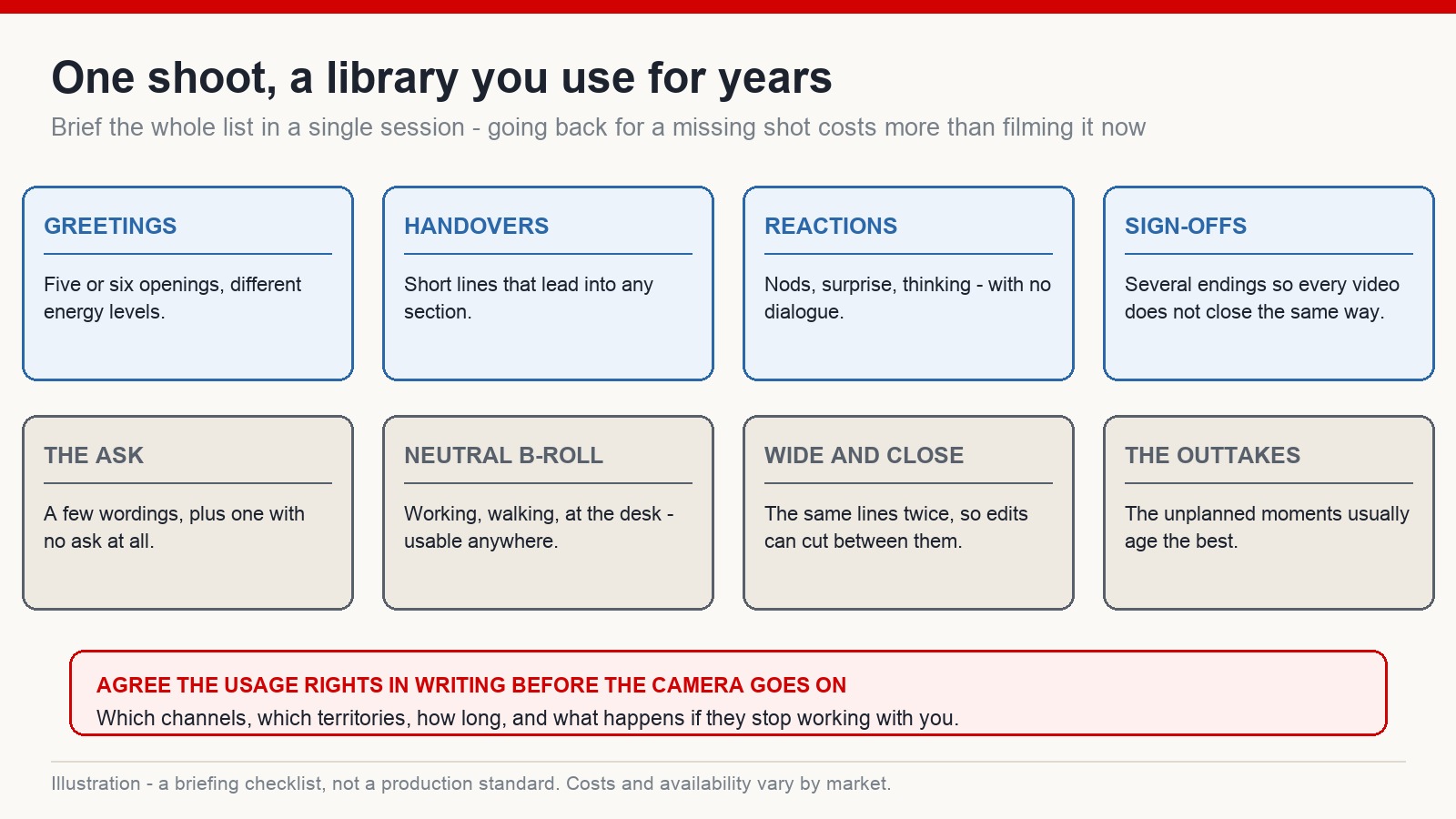
Several greetings at different energy levels. Handover lines generic enough to sit between any two sections. Silent reactions — nodding, thinking, surprise — which turn out to be the most reused clips of all. A few different sign-offs. Several wordings of the ask, plus one version with no ask at all. Neutral b-roll of them working or walking. The same lines shot wide and close so the edit can cut between them. And keep the outtakes, which usually feel more human than anything scripted.
One session produces material that carries a channel for a year. Going back for a single missing shot costs more than filming it in the first place.
The paperwork nobody mentions
If you are going to build a brand on somebody’s face, settle the terms before the camera goes on: which channels the footage can appear on, which territories, for how long, and what happens if they stop working with you.
This is not legal advice, and rules differ by country — where it matters, ask a professional. But the failure mode is easy to picture. Two years of videos all opening with a person you no longer have permission to use is an expensive way to learn about licensing.
It is also why I would not put the entire identity of a channel into a hired face. The format, the subject and the point of view should survive a change of presenter.
Where a face does not help
A presenter is not a repair for a weak channel, and it is worth saying so.
If nobody is clicking, the problem is the promise in the title and thumbnail, and adding a person changes nothing. If viewers leave in the first minute, the opening is starting in the wrong place. If the subject has no audience, a friendly face will not create one.
There are also formats that are genuinely better without a host — ambient and relaxation content, some documentary styles, anything where a cut to a talking person breaks the spell. Test it on a few videos rather than rebuilding the whole channel on a theory.
And it adds a dependency. Someone else’s availability now sits inside your schedule, which is exactly the thing faceless production was supposed to avoid. The library approach exists to keep that dependency small.
Making videos versus running an operation
The people who make videos think about the next video. Finish it, publish it, start again from nothing.
The people who last think about the next hundred videos, the next channel, and which parts of the work will still exist in three years. A reusable presenter library is one of those parts. So is a house style, a format that does not need reinventing weekly, and a system somebody else could run.
Tools will keep changing and getting cheaper. Recommendation systems will keep updating. What survives all of that is the combination that is hardest to copy: automation for speed, a human for trust, and a recognisable identity for the years in between.
Will AI replace people who make YouTube videos?
It is replacing tasks rather than people. Scripting drafts, voice-over, editing and thumbnails are all partly automatable now. Judgement about what is worth making, and the identity a viewer attaches to, are much harder to hand over.
Does a faceless channel need anyone to appear on camera?
No. It is optional. But a short human presence at the opening or the close tends to make a channel feel accountable, and accountability is the scarce thing when production is not.
Is hiring a presenter worth it for a small channel?
Only if you intend to keep going. It is a poor purchase for five videos and a reasonable one for two hundred, because the same session is reused across all of them. Costs vary widely by market, so get a couple of quotes before deciding.
If you want the full build for an English-speaking faceless channel, that is what I put together at mmoyoutube.com.